 REAP
REAP
A development pipeline where AI and humans collaborate to evolve an Application across successive Generations. Context persists between sessions, development follows a structured lifecycle, and design docs evolve with your code.
AI agents are powerful — but without structure, development becomes chaotic. Context resets every session. Code changes scatter without purpose. Design docs drift from reality. Lessons from past work vanish.
REAP consists of four interconnected layers: Knowledge provides the basis, Vision drives direction, Generations execute the work, and Civilization is what evolves.
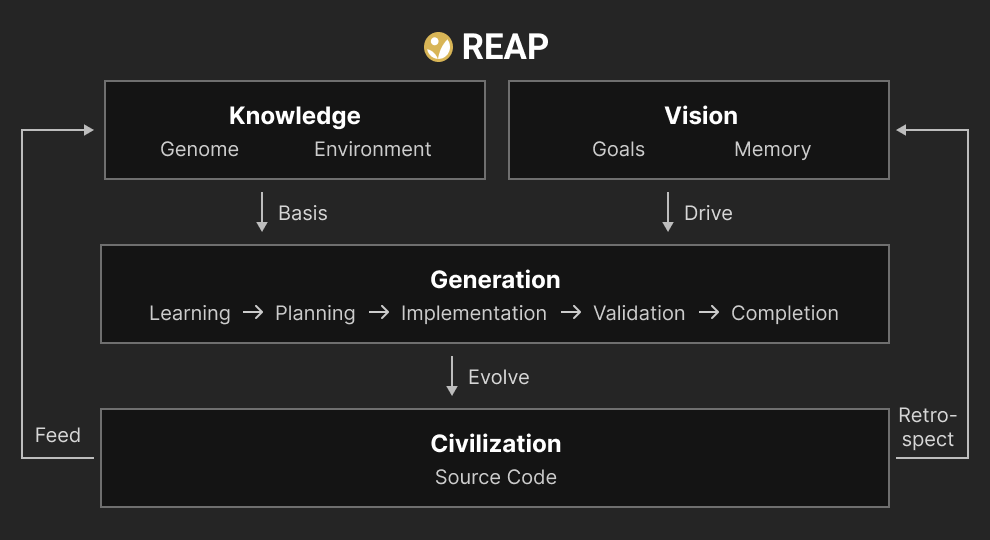
Each generation progresses through five stages, from goal definition to retrospective and archiving.
| Stage | What happens | Artifact |
|---|---|---|
| Learning | Explore project, build context, review genome and environment | 01-learning.md |
| Planning | Break down tasks, choose approach, map dependencies | 02-planning.md |
| Implementation | Build with AI + human collaboration | 03-implementation.md |
| Validation | Run tests, verify completion criteria | 04-validation.md |
| Completion | Reflect + fitness feedback + adapt genome + archive (4 phases) | 05-completion.md |
npm install -g @c-d-cc/reap # Global installation requiredclaude
> /reap.init # Set up genome, environment, vision through guided conversation
> /reap.evolve # Run a full generation lifecycle/reap.evolve runs the full generation lifecycle — Learning through Completion — autonomously. You can also control stages manually with stage commands.