

Core Concepts
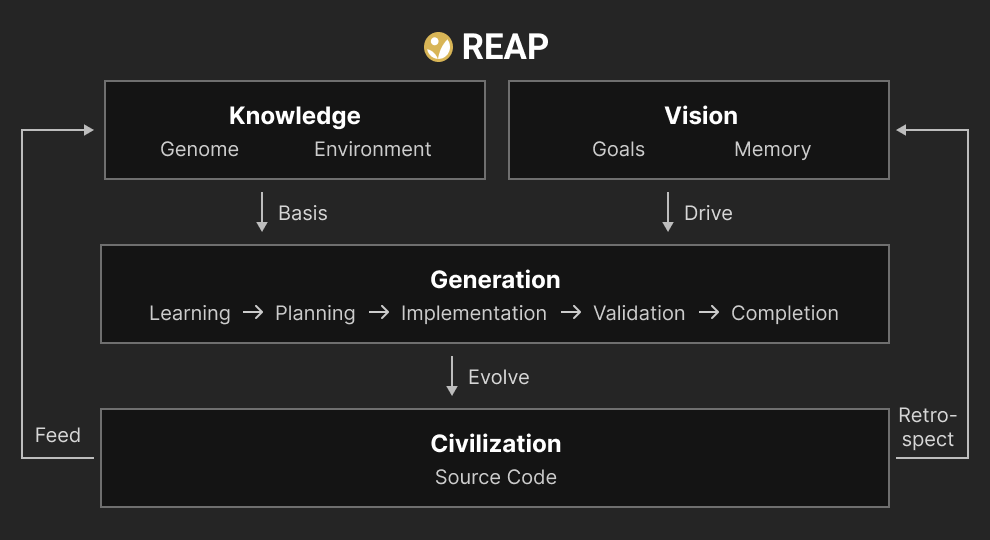
4-Layer Architecture
REAP consists of four interconnected layers:
Long-term goals and direction. Goals drive each generation. Memory persists context across sessions.
Genome (prescriptive — how to build) + Environment (descriptive — what exists). The basis for each generation.
A single evolution cycle driven by Vision, grounded in Knowledge. Follows Learning → Planning → Implementation → Validation → Completion.
Source code and all project artifacts outside .reap/. What generations evolve. Lessons feed back into Knowledge.
Key Principles
Never modified during a normal generation. Changes go through backlog → Completion adapt phase. (Embryo generations allow free modification.)
No quantitative metrics. The human's natural language feedback is the only fitness signal.
The AI adjusts communication depth based on context clarity — from active dialogue to autonomous execution. See Self-Evolving Features for details.
Lifecycle Overview
Each generation follows five stages, producing artifacts at each step:
| Stage | What happens | Artifact |
|---|---|---|
| Learning | Explore project, build context, review genome and environment | 01-learning.md |
| Planning | Task decomposition + implementation plan | 02-planning.md |
| Implementation | Code with AI + human collaboration | 03-implementation.md |
| Validation | Run tests, verify completion criteria | 04-validation.md |
| Completion | Reflect + fitness feedback + adapt genome + archive (4 phases) | 05-completion.md |
→ Lifecycle details · → Backlog & Deferral
Session Context Loading
When you open a REAP project, CLAUDE.md instructs the AI agent to read genome, environment, and the REAP guide. The agent immediately loads the project's knowledge and understands the current state.
Evolution Flow
Knowledge compounds across generations. Each generation evolves the Genome, and lessons accumulate in Lineage:
Generation #1 (Genome v1)
  → Learning: explore project, build context
  → Planning → Implementation
  → OAuth2 need discovered → genome-change logged in backlog
  → Validation (partial)
  → Completion: reflect → fitness → adapt (genome v2) → commit → Archive

Generation #2 (Genome v2)
  → Learning: review updated genome, deferred tasks
  → Vision-driven goal: "OAuth2 integration + permission management"
  → ...